
High-precision parts in the micrometre range. Complex assemblies with tight tolerances. Series production without quality fluctuations. Anyone who has to meet these requirements knows that what matters is not just who manufactures your parts, but when and to what extent a manufacturing partner is integrated into your project.
High precision doesn’t begin with the machine
With high-precision parts, every design decision determines optimal manufacturability, process stability and cost. This is a tolerance that cannot be reproduced in series production. A geometry that triples the reject rate. A material that doubles machining time.
Only those who combine manufacturing experience with sound process expertise understand these relationships. That’s precisely why co-engineering for complex precision parts is not just an option, but the foundation for stable series production.
What co-engineering means in practical terms
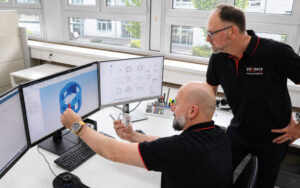
Polymeca joins a project as early as the initial development phase. Specialists work with the customer to determine whether the product is designed for manufacturability, drawing on over 100 years of manufacturing experience.
Tolerances are realistically assessed before they are defined. Geometries are checked for process stability. Materials are analysed with regard to Total Cost of Ownership.
The result is a product that not only works on paper but can be reliably produced in series.
Suitability for series production will be determined before series production starts
The most critical moment lies in the transition from prototype to series production. At Polymeca, process stability and tolerances are tested and evaluated together with the customer during the development phase, before they become a risk in series production.
Quality is not only achieved, but also transparently documented. Planning security is not determined on paper, but in the real production environment.
The risks multiply when dealing with assemblies
A precision part can be correct on its own and still cause problems in the assembly if tolerance chains are not co-ordinated, interfaces have not been considered or system interrelationships only become apparent during assembly.
This is precisely where co-engineering has its greatest impact. Those who think of assemblies as a system from the outset, evaluate tolerance chains across the board, define interfaces early on and integrate functional testing into the development process, avoid problems that can only be resolved later with considerable effort.
Profit and gain:
Cost security: Co-engineering identifies cost drivers before they arise. The Total Cost of Ownership decreases over the entire product lifespan.
Reliable feasibility studies: No promises that are compromised in series production. Instead, verifiable figures and sound decision-making criteria.
Suitability for series production without start-up difficulties: Processes are validated before series production begins. What works, works reliably.
Faster time to market: All process steps, from prototype to series production, take place at Polymeca. This shortens co-ordination times, accelerates adjustments and eliminates the need to switch suppliers.
Clear responsibilities: A dedicated project manager co-ordinates customer purchasing and technology with manufacturing. Costs, deadlines and quality are transparent to everyone at all times.
High-precision parts and complex assemblies leave no room for late corrections. Co-engineering with Polymeca means that manufacturing expertise is applied where it has the greatest impact – at the beginning.